
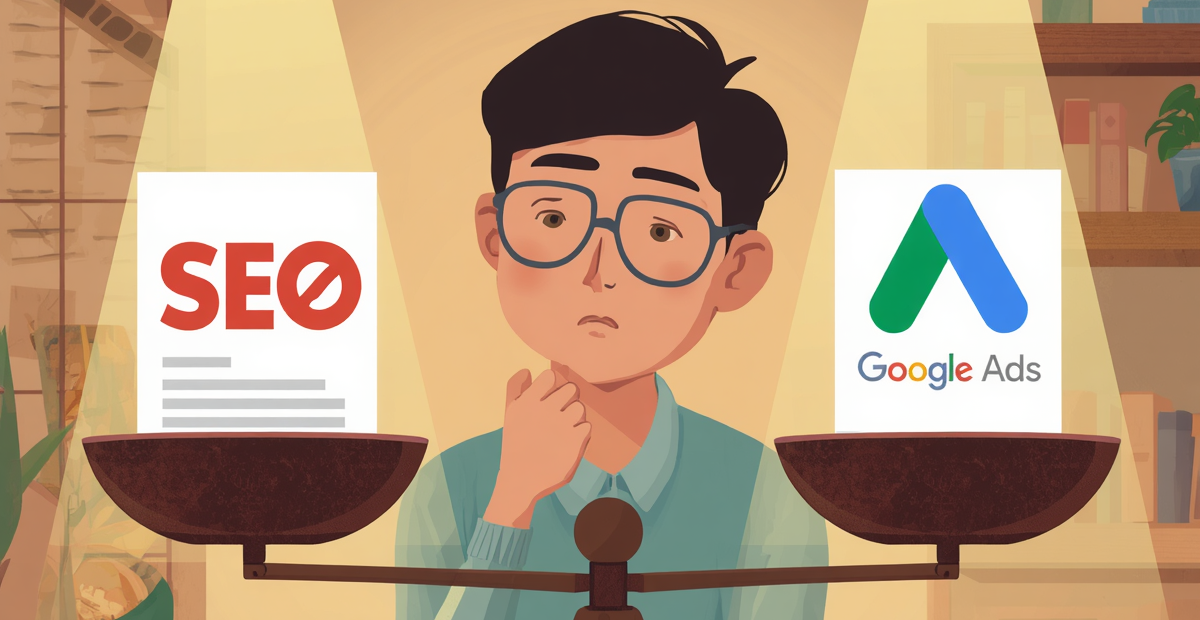
It is one of the most common questions I get from business owners: should we invest in SEO or Google Ads? Both drive traffic from Google. Both can generate leads and sales. But they work in fundamentally different ways, operate on different timelines, and deliver different kinds of value. The honest answer is that the best choice depends on your business goals, budget, and growth stage — and in many cases, the right answer is a strategic combination of both.
In this blog, we break down SEO and Google Ads across the dimensions that matter most to growing businesses: cost, speed, sustainability, targeting, and ROI. By the end, you will have a clear framework to decide where your marketing investment should go.
Understanding SEO: The Long Game
Search Engine Optimisation (SEO) is the practice of improving your website’s visibility in organic (unpaid) search results. When someone searches for a term related to your business and your website appears on page one, that is SEO at work. It involves a combination of technical website optimisation, high-quality content creation, and building authoritative backlinks from other websites.
The defining characteristic of SEO is that it takes time. Most businesses do not see meaningful organic ranking improvements for three to six months after beginning a serious SEO programme. However, once those rankings are established, they deliver consistent, compounding returns — traffic that costs nothing per click and that continues flowing even when you are not actively spending.
Performance Insight: Think of SEO like building an asset. The effort and investment you put in today appreciates in value over time, delivering increasing returns without proportionally increasing costs.
Understanding Google Ads: The Fast Lane
Google Ads (formerly Google AdWords) is a paid advertising platform that places your business at the top of search results for chosen keywords, immediately. You set a budget, define your target keywords and audience, create your ads, and your campaigns can be live and generating clicks within hours.
The defining characteristic of Google Ads is speed and control. You decide exactly which keywords trigger your ads, what your ads say, which landing pages users see, and how much you spend. The moment you pause your campaigns, however, the traffic stops. Unlike SEO, Google Ads does not build a lasting organic asset — it is a tap that runs as long as you keep paying.
Head-to-Head: The Key Differences
1. Cost Structure
SEO requires investment in content creation, technical optimisation, and link building — either through agency fees, in-house talent, or both. The ongoing cost per visit decreases over time as rankings improve and traffic grows. Over a 12-to-24-month horizon, the cost per organic visit can be dramatically lower than paid search.
Google Ads operates on a pay-per-click (PPC) model. Every click costs money, and costs vary by industry and competition. In highly competitive sectors — insurance, legal services, real estate — clicks can cost hundreds of rupees each. The moment your budget runs out, your visibility disappears. There is no residual benefit.
2. Speed to Results
Google Ads wins decisively on speed. A well-structured campaign can drive qualified traffic to your website on day one. For businesses that need immediate leads — a new product launch, a seasonal promotion, or filling a sales pipeline quickly — Google Ads is the only viable option.
SEO is a longer-term commitment. It requires patience, consistency, and a tolerance for delayed gratification. But the payoff, when it arrives, is often greater in scale and far more cost-efficient per conversion.
3. Trust and Click Behaviour
Research consistently shows that organic search results receive a higher proportion of clicks than paid ads for most query types. Users have developed an awareness of paid placements and often scroll past them in favour of what they perceive as more trustworthy organic results. For informational and research-stage queries especially, organic listings outperform paid ads in click-through rate.
That said, for transactional queries — ‘buy running shoes online’, ‘hire a plumber in Chennai’ — paid ads with strong extensions and landing pages convert exceptionally well because the user intent is immediate and commercial.
4. Targeting Precision
Google Ads offers granular targeting control that SEO cannot match. You can target by keyword match type, device, location, time of day, audience segment, and even competitor brand terms. You can run A/B tests on ad copy within days and optimise based on conversion data rapidly.
SEO targets keywords through content, but you cannot control when and how Google ranks your pages — you can only influence it. Google Ads gives you the dial; SEO requires you to earn the ranking.
5. Sustainability and Compounding Value
This is where SEO holds a decisive long-term advantage. A well-ranked blog post, service page, or product category can continue driving traffic and generating leads for years with minimal ongoing investment. That compounding value makes SEO one of the highest-ROI marketing strategies over a multi-year horizon.
Google Ads delivers value only while you are spending. There is no compounding. The moment your budget is cut, your presence on Google evaporates.
Which Should You Choose?
The answer depends on where your business is and what it needs right now:
- Early-stage business or new market entry: Google Ads first — you need traffic and leads now, while you build your organic foundation in parallel
- Established business with content assets: double down on SEO to reduce paid dependency and lower long-term customer acquisition cost
- Seasonal or promotional campaign: Google Ads — fast, targeted, and switch-offable when the campaign ends
- Competitive market with high CPCs: invest heavily in SEO to reduce reliance on expensive paid clicks over time
- Limited budget: SEO delivers better long-term ROI but requires patience; Google Ads can be started with a small daily budget for immediate data
Performance Insight: The most effective growth strategy I have seen for SMBs is running Google Ads to generate immediate revenue while simultaneously building SEO — then gradually shifting budget from paid to organic as rankings improve and cost per acquisition from SEO drops below that of paid search.
The Case for Doing Both
For most businesses with the budget to support both, an integrated approach delivers superior results. Google Ads provides immediate traffic, conversion data, and keyword intelligence that directly informs your SEO strategy. SEO reduces your paid traffic dependency over time and builds brand authority that improves your ad Quality Scores — which lowers your cost per click in Google Ads.
Together, they create a full-funnel, always-on search presence: paid ads at the top for high-intent transactional queries, and organic rankings for informational and mid-funnel content that builds trust and nurtures prospects.
Conclusion
SEO and Google Ads are not rivals — they are complementary tools in a sophisticated digital marketing strategy. Google Ads is your accelerator; SEO is your engine. One delivers speed, the other delivers sustainability. The businesses that grow fastest are those that learn to run both intelligently, letting each channel’s strengths offset the other’s limitations. The question is not which is better. The question is which is right for your business, right now — and how quickly you can build toward a strategy that leverages both.

Leave a Reply